
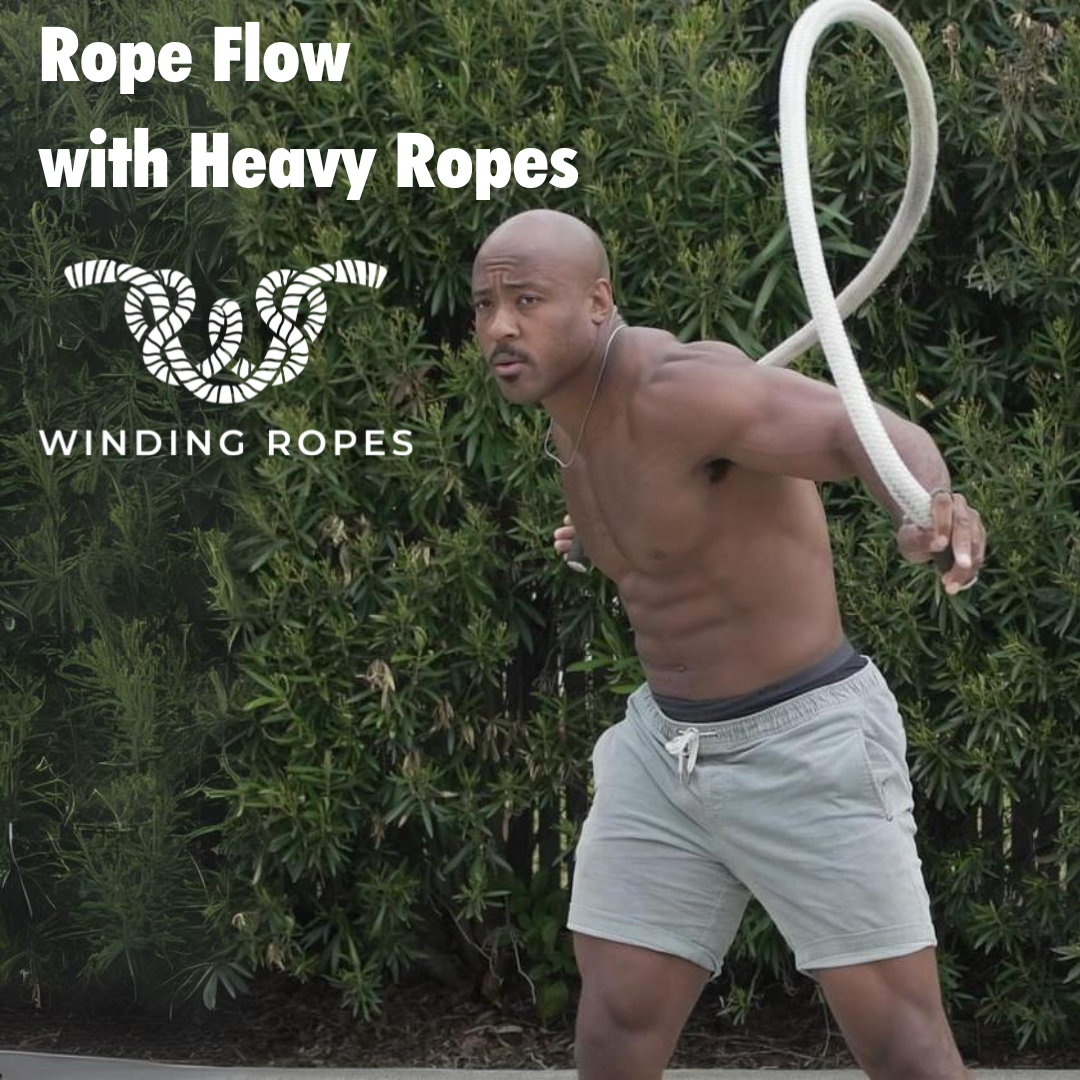
The Rope Flow Workout: Mobility, Cardio and Exercises
Last updated August 2026.
A rope flow workout is a continuous, flowing session with a weighted rope that trains shoulder and spine mobility, low-impact cardio and coordination at the same time. You move the rope in looping figure-8 patterns around your body for a set time, so instead of counting reps you flow for rounds. Ten to fifteen minutes is a genuine full-body session, and because the rope never hits the ground it is easy on the joints. New to the practice? Start with What Is Rope Flow?

Why rope flow is a mobility game-changer
Most training loads muscles. Rope flow mobilises them. The weighted rope pulls your shoulders and upper spine through a full, natural range on every arc, so you build mobility while you move rather than sitting in static stretches. That is why so many people use rope flow to undo desk posture and warm up before lifting or sport.
The weight is what makes it work. A heavier rope carries momentum, so your body learns to move with the load through the shoulder, thoracic spine and hips. Lighter ropes are faster but teach less about moving heavy tissue smoothly.
"Great rope that is giving me serious help in regaining my fluidity in training. If you are interested in taking your fitness culture to the next level of suppleness and fluidity of movement, you have got to get a rope from Winding Ropes."
Luther P., verified 5-star review, Red Wolf 650 g
A beginner rope flow workout (10 minutes)
This routine uses the foundational moves taught in the Winding Ropes tutorials.
- Warm-up flow (2 min). Easy overhand figure-8s, the "raise and chase" pattern: one hand races, the other chases, thumb leading. Face "South" and just find the rhythm.
- Overhand rounds (3 x 1 min). Keep the overhand figure-8 going, switching which hand leads. Rest 30 seconds between rounds.
- Add the underhand (2 min). Switch to underhand figure-8s (pinky leading), the mirror of the overhand.
- Link with the propeller (2 min). Use the side-rolling propeller to transition between overhand and underhand through the cardinal points (South to North).
- Cool-down flow (1 min). Slow, smooth figure-8s, long and relaxed.
Do this three to five times a week. As it gets easy, add rounds, add footwork, and move up the levels. Rope flow also works as a recovery session between hard training days: see Why Active Recovery with Rope Flow Works.
The core rope flow exercises
Every rope flow workout is built from a handful of moves seen from four directions (the "cardinal points"):
- Overhand figure-8 ("raise and chase", thumb leads): the foundation.
- Underhand figure-8 (pinky leads): the mirror image.
- Propeller: the transition that links overhand and underhand.
- Matador's wheel (overhand and underhand): a horizontal-plane move, Level 2.
- Dragon Roll: Level 3, a signature flowing move.
- The Sneaks (overhand, underhand, tandem): Levels 6 to 8, the advanced vocabulary.
Learn them in order and your "workout" becomes an endless flow you can extend for as long as you like. The full path runs across eight levels of free tutorials.
How heavy should your workout rope be?
For a mobility-focused workout, a heavy rope (around 550 g to 1.6 kg) is the sweet spot: enough weight to feel the stretch and momentum, not so much that form breaks down. Beginners often start with a 12 mm or 14 mm rope (roughly 450 to 650 g) and add weight as technique improves. The complete ladder, with every current rope and price in one table, is in Which Flow Rope Should You Start With? The Complete Weight Guide. Every Winding Ropes rope is made in Australia and assembled by hand in Melbourne.

"Light enough for me to still perform my favourite patterns, this rope is ideal for smoothing out my flow. It provides strong feedback on twist in the rope."
Wayne, verified 5-star review, Great White Shark 1.5 kg
FAQs about the rope flow workout
Is rope flow a good workout?
Yes. Flowing continuously is genuine low-impact cardio, and the weighted rope trains shoulder and spine mobility plus grip and coordination in the same session. Ten to fifteen minutes is a full-body workout.
How long should a rope flow workout be?
Ten to fifteen minutes is plenty for a full session. Even five minutes works as a warm-up before lifting or sport.
Does rope flow build muscle?
It builds mobility, endurance, grip and coordination more than raw size. The heavier the rope, the more strength you develop through the shoulders, forearms and core.
How often should I do rope flow?
Three to five times a week suits most people. It is low-impact, so daily short flows are fine too.
Is rope flow good for shoulder mobility?
Yes, that is one of its biggest strengths. The figure-8 moves the shoulders and upper spine through a full range under gentle load, which is why it is popular for warm-ups and desk-posture recovery. Real experiences: what customers say about shoulders.